
Formal and Informal Greetings in English – 12 Essential Phrases

Welcome to Hello English! Greetings are more than just “hello”—they set the tone of your conversation and show respect, friendliness, or professionalism.
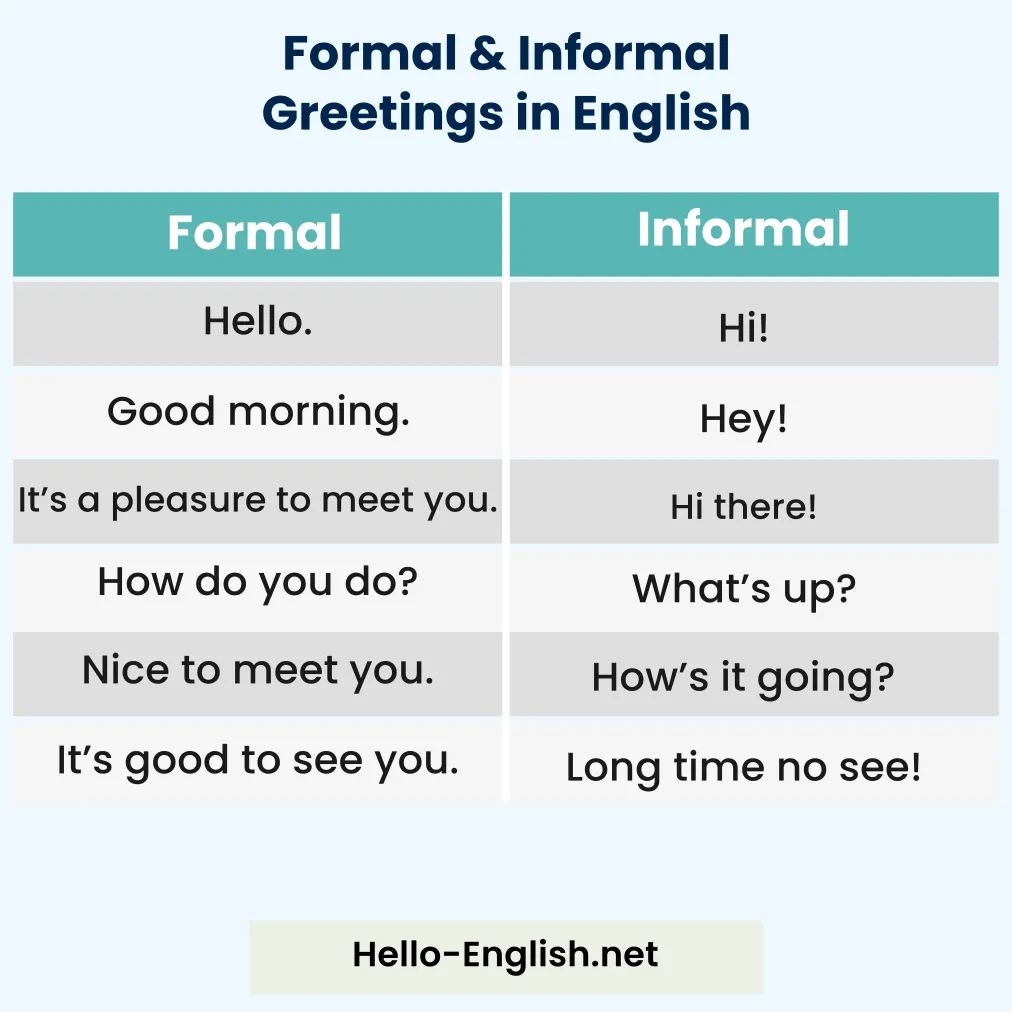
Formal and Informal Greetings in English

In this lesson, you’ll learn 12 essential greetings in English—split into basicformal, and informal categories. Whether you’re meeting a boss, texting a friend, or starting a conversation with a stranger, you’ll know exactly what to say.

Basic Greetings (Work in Almost Any Situation)

These simple phrases are your go-to for any context—neutral, polite, and universally understood.

  • Hello!
  • Hi!
  • Good morning!
  • Good afternoon!
  • Good evening!
  • Nice to meet you.

Example:
Person A: Hello!
Person B: Hi! How are you?
Person A: I’m good, thanks!

Formal Greetings (Professional & Polite)

Use these in job interviews, business meetings, emails, or when meeting someone for the first time.

  • Good morning, Sir/Madam.
  • Good afternoon.
  • It’s a pleasure to meet you.
  • How do you do?

Response tip: To “How do you do?”, simply reply: “How do you do?” (It’s a fixed phrase!)

Example:
Person A: Good afternoon, Ms. Lee. It’s a pleasure to meet you.
Person B: Good afternoon! The pleasure is mine.

Informal Greetings (Casual & Friendly)

Perfect for friends, family, classmates, or relaxed settings.

  • Hey!
  • Hi there!
  • What’s up?
  • How’s it going?
  • Yo!

Example:
Person A: Hey! Long time no see!
Person B: Hi there! Yeah, how’s it going?

Quick Tip

When in doubt, start with “Hello” or “Hi”. You can adjust your tone as the conversation unfolds!

Cultural Notes

• UK: More formal greetings are common in professional settings.
• US: Even at work, “Hi” or “Hey” is often acceptable.
• Australia: “G’day!” is widely used—even in offices!

Practice Tip

Write two greetings: 1. One you’d use in a job interview 2. One you’d text to a friend Say them out loud to feel the difference!

Now you’re ready to greet anyone—in any situation—with confidence! Bookmark this guide or try our interactive quiz to test your greeting skills.

Happy learning! 👋

Similar Posts

  • 10 Ways to Accept a Suggestion

    In English, knowing how to 10 Ways to Accept a Suggestion is essential for smooth and friendly conversations. When someone offers an idea—whether it’s for dinner, a weekend activity, or a new project—you need more than just a simple “yes.” Learning different phrases helps you sound natural, polite, and interested, which is key to making…

  • 11 Ways to Say “That’s Terrible”

    Have you ever heard bad news and wanted to respond with sympathy or shock? Saying “That’s terrible” is a common and caring way to react in English. In this lesson, you’ll learn 11 natural, real-life expressions you can use to show you care—whether you’re talking to a friend, coworker, or stranger. Common Ways to Say…

  • 20 Ways to Reply to “Thank You”

    So, someone has just thanked you. What’s your reply? While “You’re welcome” is always correct, there are many other natural and friendly ways to reply to “Thank You” in English! Mastering these phrases will make your conversations smoother and help you sound more like a native speaker. Let’s explore 20 great options! 20 Ways to…

  • 10 Ways to Say “Take Your Time”

    In English, “Take your time” is a simple and common phrase. It tells someone that there is no need to hurry and that you are happy to wait. But if you use the same phrase all the time, your English can sound boring! Knowing 10 Ways to Say “Take Your Time” will help you sound…

  • 10 Ways to Express Surprise

    Have you ever heard unexpected news and didn’t know what to say in English? Whether it’s good news like a friend’s promotion or shocking news like a sudden change of plans, knowing how to express surprise naturally will help you react with confidence. In this lesson, you’ll learn 10 ways to express surprise—plus a few…

  • 10 Ways to Say “I See” or “I Understand”

    In English, the simple phrases “I see” and “I understand” are great for confirming you’ve received a piece of information. However, relying on them too much can make you sound a little robotic. Learning 10 Ways to Say “I See” or “I Understand” will help you show varying degrees of comprehension, from a simple acknowledgement…

Leave a Reply