
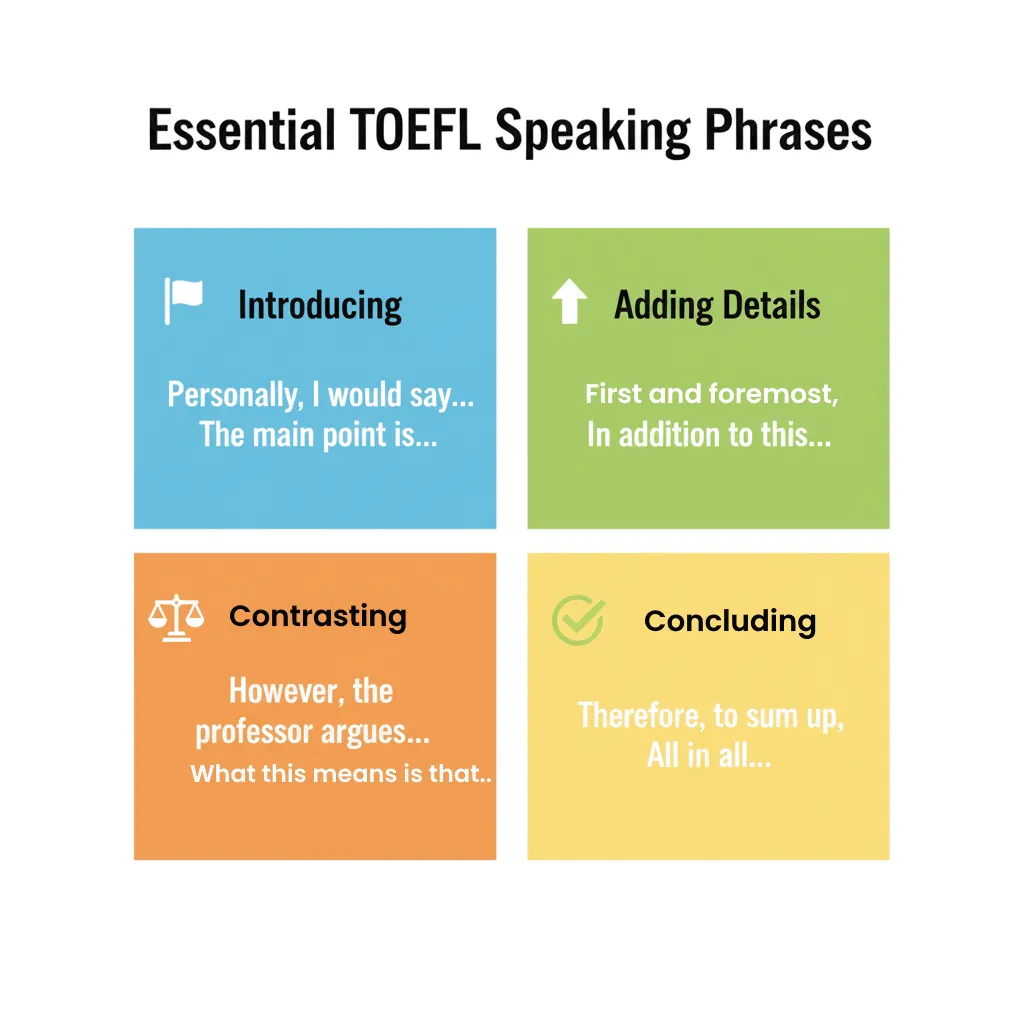
Essential TOEFL Speaking Phrases
The TOEFL Speaking section tests more than just your vocabulary—it tests how well you can organize your ideas clearly and quickly! Using specific transition phrases for TOEFL Speaking Task questions will make your answers sound organized, academic, and easy for the grader to follow. Let’s master these essential expressions!

Essential Phrases for TOEFL Speaking Task
Here are the most useful phrases for TOEFL Speaking Task organized by the function they serve in your response. Using these will help you sound fluent and confident.
1. Introducing Your Topic (Independent & Integrated Tasks)
These phrases immediately tell the examiner what you are going to talk about.
1. Personally, I would say… This is perfect for the Independent Speaking Task (Task 1) where you state your opinion.
- Meaning: Stating your personal preference or belief.
- Example: “Personally, I would say the most important life skill is learning how to manage your time.”
2. The main point of the reading/lecture is… Use this to start the Integrated Speaking Tasks (Tasks 2, 3, 4) where you need to summarize information.
- Meaning: Identifying the central idea or theme.
- Example: “The main point of the lecture is to explain the two distinct ways that plants attract insects.”
3. I completely agree/disagree with this statement. A direct way to show your stance in an Independent Task (Task 1).
- Meaning: Expressing strong agreement or disagreement.
- Example: “I completely agree with this statement because working in a team is always more efficient than working alone.”
2. Presenting Your Reasons and Examples (All Tasks)
Good TOEFL Speaking answers always support the main point with details. Use these to structure your arguments.
4. First and foremost, … A strong, clear way to introduce your primary reason or the first piece of information.
- Meaning: The most important reason; starting the explanation.
- Example: “First and foremost, remote work allows employees to save money on commuting costs.”
5. One reason for this is… / A second reason is… A very clear numerical structure for listing points.
- Meaning: Introducing distinct points that support your main idea.
- Example: “One reason for this is that dogs are very loyal companions. A second reason is that they encourage owners to exercise.”
6. For instance, … / To illustrate this point, … These academic phrases signal to the listener that an example is coming.
- Meaning: Giving a specific example to support the previous statement.
- Example: “Online education is flexible. For instance, students can watch lectures whenever they want, even late at night.”
- Example: “To illustrate this point, the professor described an experiment involving two groups of students.”
7. In addition to this, … / Moreover, … Use these to add more information or another supporting idea.
- Meaning: Adding a supplementary point.
- Example: “Studying abroad is an excellent cultural experience. In addition to this, it greatly improves language skills.”
3. Contrasting and Reporting (Integrated Tasks)
These are crucial for Task 3 and Task 4, where you must compare two pieces of information (usually reading vs. lecture).
8. However, the professor argues that… This is a high-level transition phrase used to introduce a contradiction or differing view from the reading.
- Meaning: Introducing a contrast or conflicting idea.
- Example: “The reading suggests recycling is expensive. However, the professor argues that in the long term, it actually saves the city money.”
9. The speaker brings up two examples. A phrase to transition into the details of the lecture/conversation.
- Meaning: Signaling that you are about to list examples from the spoken source.
- Example: “The speaker brings up two examples to clarify the concept of mimicry in nature.”
10. What this means is that… Use this to clarify or interpret a complex idea from the lecture.
- Meaning: Explaining the significance or definition of something.
- Example: “The company decided to downsize the department. What this means is that several people will be losing their jobs next month.”
4. Concluding Your Response (All Tasks)
Always finish your response clearly. Even a short conclusion helps your score!
11. Therefore, to sum up, … A slightly formal but highly effective way to signal the end of your Independent Task response.
- Meaning: In conclusion; summarizing the entire argument.
- Example: “Therefore, to sum up, I feel that a traditional classroom setting is more beneficial than online learning for all the reasons I have mentioned.”
12. All in all, … A slightly less formal way to conclude, but still very clear.
- Meaning: Considering everything; overall.
- Example: “All in all, the professor clearly believes that the negative environmental impacts outweigh the economic benefits.”
Mastering these phrases for TOEFL Speaking Task responses will immediately boost your organization score. Try using these structures when you practice your next TOEFL Speaking prompt. Practice makes perfect! Good luck with your exam preparation! 👋